

Hormuz, April 23: Iran Seizes Two Ships Hours After Ceasefire Extended. The Pentagon Says Mines Could Take Six Months to Clear.
Wednesday’s escalation in the Strait of Hormuz has fundamentally reset the global shipping timeline. With the Pentagon estimating a six-month window for mine clearance and oil prices flirting with $100 a barrel, the Cape of Good Hope is no longer a temporary detour. It is the baseline route for 2026.

CAPE Opens April 20: The Official CBP FAQ, Translated Into Plain English
CBP has published its official FAQ for the CAPE refund process, and it answers a number of questions that importers and brokers have been sitting with since the system was announced. Some of the answers are reassuring. A few carry details that will catch people off guard if they do not read carefully. This post goes through all of it.

CAPE Phase 1 Launches April 20. What It Covers, What It Does Not, and What to Do Before It Goes Live
The long-awaited refund process for IEEPA duties finally has a firm start date. On April 1, the Court of International Trade confirmed that U.S. Customs and Border Protection (CBP) is on track to deploy Phase 1 of the CBP Automated Processing Engine (CAPE) on April 20, 2026.
For importers who have been waiting on the sidelines while hundreds of millions of dollars in interest accrue each month, this is the green light to move from theory to execution. However, Phase 1 is not a "catch-all" solution. It is a targeted launch covering approximately 63% of eligible entries. Knowing whether your entries fall into this first wave is critical for your cash flow planning.

Two Major Tariff Actions Signed April 2: What Importers Need to Know Before April 6
U.S. trade policy has entered a new era of complexity. As of 12:01 a.m. today, April 6, 2026, the restructuring of Section 232 tariffs on steel, aluminum, and copper has officially taken effect. With no exceptions for goods already on the water, importers of derivative metal products are facing an immediate shift in how duties are calculated and assessed.
This action was paired with a significant executive order targeting patented pharmaceuticals, creating a high-stakes environment for two of the most critical sectors in global logistics.

Section 232 Steel and Aluminum: What CBP's Latest Guidance Actually Changes
Section 232 tariffs on steel and aluminum are at 50% and the derivatives list has grown to cover hundreds of product codes. The rate and the scope are not the hard part. The hard part is the calculation, and CBP's Base Metals Center of Excellence just issued guidance that clarifies three things that have been generating real confusion.
First: when a derivative article contains both subject content and non-subject content, shared costs like labor, overhead, and packaging get apportioned across both entry lines based on a value ratio. Second: if a non-steel product like perfume or canned beer appears on the derivatives list, the Section 232 duty applies to the cost of the metal container, not the product inside it. Third: iron articles now follow the same content valuation method as steel and aluminum, with a timeline of rule changes since 2025 that matters if iron parts are part of your import program.
The consequence of getting this wrong is not a small one. CBP has confirmed that if an importer cannot document the steel or aluminum content value in a derivative article, the entire entered value is subject to the 50% duty. Documentation is not optional.

Your IEEPA refund is coming. Here is what needs to be in place before you can receive it
The CAPE portal opens around mid-April. Most importers are focused on pulling entry data, which makes sense. But the thing most likely to hold up your refund has nothing to do with entries. It is simpler than that: CBP needs your banking information on file before they can pay you anything.
Paper checks are gone. Since February 6, every CBP refund goes out electronically through ACE. No banking information on file means your refund goes into a suspense account with no interest and no automatic reissuance. It stays there until you sort out the enrollment yourself and request the payment again. That is an avoidable situation on money you are already owed.
Getting set up requires two things: an ACE Portal account structured at the right level, and ACH banking information registered within the Importer Sub-Account. Neither is complicated, but both have traps that catch importers who assume they are already set up correctly. The name on your ACE account has to match what CBP has on file exactly, not approximately. And if you do not have a U.S. bank account, there is a separate process through CBP Form 4811 that lets you authorize a customs broker to receive refunds on your behalf.

Every Emergency Fuel Surcharge Now Hitting Transpacific Lanes, Broken Down

CAPE Is Coming: What Importers Need to Know About CBP's IEEPA Refund System

The Strait of Hormuz Is Closed: What Asia-North America Shippers Must Do Now
The Strait of Hormuz, the narrow waterway through which approximately 20% of the world's oil supply and 20% of global LNG passes, is effectively closed following joint U.S. and Israeli military strikes on Iran. Protection and indemnity insurance was withdrawn by March 5, making commercial transit economically unviable, and tanker traffic has since dropped to near zero. An estimated 132 vessels carrying around 501,000 TEU are currently trapped inside the Persian Gulf.
All four of the world's largest container carriers, Maersk, MSC, CMA CGM, and Hapag-Lloyd, have suspended Gulf transits and are rerouting around the Cape of Good Hope, adding 10 to 14 days to voyage times. Transpacific spot rates are already climbing, war risk surcharges are in effect, and analysts warn that fuel and insurance costs will continue pushing rates higher across Asia-North America lanes in the weeks ahead.
This is also the first time in container shipping history that both the Strait of Hormuz and the Red Sea have been simultaneously disrupted, removing two of the world's most critical maritime shortcuts from the routing equation at once. For shippers managing inventory across Transpacific and Indian Subcontinent corridors, the time to review contingency plans is now.
Read the full trade update to understand how this disruption affects your freight rates, routing options, and customs compliance posture.
CBP Outlines 45-Day Roadmap for IEEPA Refunds
Following the recent court order regarding IEEPA tariffs, Customs and Border Protection (CBP) has officially outlined a 45-day technical roadmap to handle the massive refund process. To avoid the chaos of millions of individual payments, CBP is developing a streamlined ACE functionality that will consolidate refunds and interest by importer. Shiptech is tracking this development closely to help you prepare your entry declarations and ensure your business is at the front of the line once the system goes live.

The Impact of the Strait of Hormuz Closure on Global Trade
The closure of the Strait of Hormuz has triggered an overnight crisis in global shipping, forcing major carriers like MSC, Maersk, and CMA CGM to immediately reroute or suspend services. With vessels now taking the long way around Africa, businesses should expect transit delays of up to 20 days, significant container shortages, and new emergency surcharges. Shiptech is tracking these shifts in real time to help you navigate rising costs and shifting schedules while keeping your supply chain moving.
The Great Tariff Pivot: Analyzing the SCOTUS Ruling and the Shift to Section 122
This week, American trade policy underwent a fundamental transformation. In a 6,3 decision for Learning Resources, Inc. v. Trump, the Supreme Court struck down the use of the International Emergency Economic Powers Act (IEEPA) for broad tariffs, declaring them unlawful and opening the door for billions in potential importer refunds.
Canada Plays It Cool on CUSMA. What It Means for North American Trade
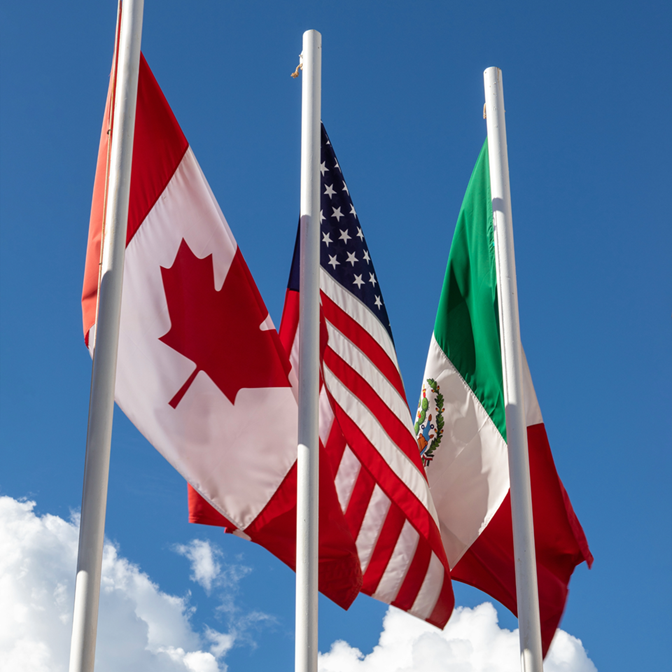
The 2026 CUSMA review is rapidly approaching. While Canadian officials are taking a measured approach to trade negotiations, businesses cannot afford to wait for policy stability. Read our full analysis on the current climate and what it means for North American freight.

USPS to Hike Shipping Rates in 2026: Commercial Shippers to Bear the Brunt
Starting January 18, 2026, the USPS is hiking shipping rates to combat a $9 billion deficit, and commercial accounts are taking the hardest hit. With business rates for Ground Advantage jumping 9.6%—far outpacing retail increases—the agency is aggressively shifting its strategy to prioritize revenue and heavier packages.

Algoma Steel Slashes 1,000 Jobs Amid U.S. Tariff Pressure
Crushing U.S. tariffs have forced Algoma Steel to accelerate its overhaul, resulting in 1,000 layoffs effective this March. Despite receiving $500 million in government aid, the company says the American market is now "closed" to them, leaving them no choice but to downsize.
Global Trade Hits the Brakes as Pre-Tariff Rush Ends
Global trade is hitting the brakes now that the pre-tariff buying frenzy has faded. The WTO’s latest numbers show a major shuffle in supply chains away from China and a sharp slowdown expected for next year.

China Agrees to Boost Farm Purchases After Tense Call Washington
President Trump announced that China has agreed to accelerate agricultural purchases following a tense phone call regarding Taiwan. The move comes as the U.S. works to finalize a trade truce and mediate a deepening diplomatic row between Beijing and Tokyo.

World Bank Cuts 2023 Global Growth Projection as Inflation Persists
WASHINGTON—The World Bank sharply lowered its growth forecast for the global economy this year as persistently high inflation has elevated the risk for a worldwide recession.

U.S. Container Imports Tumbled Close to Prepandemic Levels in December
U.S. ocean imports closed 2022 extending a monthslong slide closer to prepandemic levels, according to a new report, leaving the shipping sector bracing for deeper declines in container volumes this year.

Freight Forwarder Flexport Is Laying Off 20% of Its Workforce
Freight forwarder Flexport Inc. is cutting about 20% of its global workforce, or more than 600 workers, as the digital-focused business copes with falling shipping demand and repositions its operations to offer more supply-chain services.